Two proposals were awarded first place in this year’s Nordic Energy Challenge, held under the theme “Powering Nordic AI”. The winning entries were developed by Zheng Grace Ma and Bo Nørregaard Jørgensen from the University of Southern Denmark and by Ashish Rauniyar from the Norwegian research institute SINTEF.
As artificial intelligence becomes increasingly integrated into society, it is also transforming the energy sector. At the same time, the rapid growth of AI is driving demand for energy, data infrastructure and computing power, raising important questions about sustainability and resilience.
Against this backdrop, this year’s Nordic Energy Challenge invited participants to explore how AI can contribute to a smart, resilient and efficient energy system while addressing the challenges associated with its own development and deployment.
The challenge attracted a record 23 submissions, reflecting the growing recognition of AI’s potential to play a key role in the future Nordic energy system.
The two winning proposals
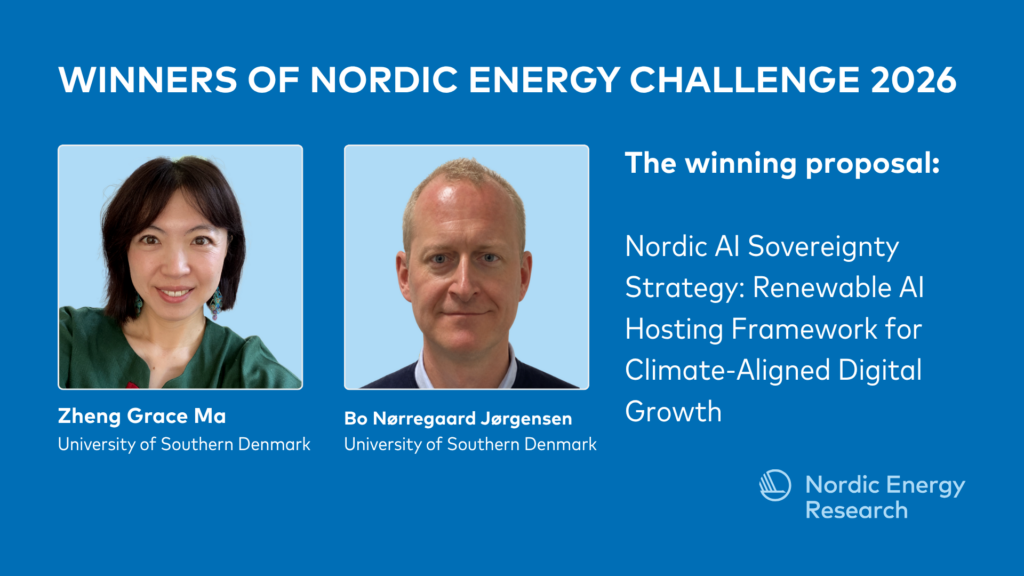
One of the two winning proposals, “Nordic AI Sovereignty Strategy: Renewable AI Hosting Framework for Climate-Aligned Digital Growth”, was developed by Zheng Grace Ma and Bo Nørregaard Jørgensen from the University of Southern Denmark.
The proposal explores how Nordic countries could coordinate AI computing across borders to make better use of renewable energy resources while reducing pressure on electricity grids. It introduces an AI-powered platform that shifts flexible AI workloads to locations and times where renewable electricity is abundant, alongside mechanisms to strengthen transparency and Nordic control over AI infrastructure.
The jury highlighted the proposal’s ability to combine energy systems, AI workloads, market mechanisms and governance into a coherent Nordic model.
“The proposal presents a long-term strategic vision that is both highly ambitious and directly relevant to current energy and digital policy challenges,” the jury stated.
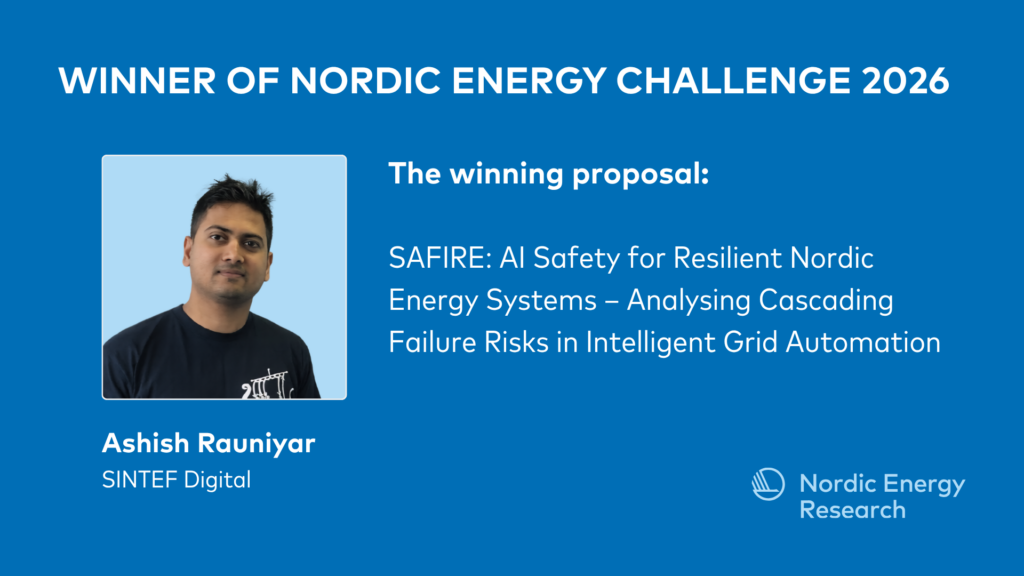
The second winning proposal, “SAFIRE: AI Safety for Resilient Nordic Energy Systems – Analysing Cascading Failure Risks in Intelligent Grid Automation”, was developed by Ashish Rauniyar of SINTEF Digital in Norway.
Rather than focusing on how AI can optimise energy systems, SAFIRE examines the risks AI itself may introduce into critical infrastructure. Using Norwegian electricity market data, the project demonstrates how machine learning models can identify early warning signals linked to system stress and potential cascading failures. The proposal also outlines practical AI safety measures and operational thresholds to support more resilient and trustworthy energy infrastructure.
“Rather than treating AI solely as a solution, SAFIRE examines how intelligent systems can unintentionally amplify crises and trigger cascading failures under stressed conditions,” the jury stated.
Second place was awarded to Sina Mahmoudi Kanesbi of the University of Vaasa for Data Follows Energy – a Nordic energy-aware compute network. The proposal uses renewable energy availability to guide the placement of flexible AI and data centre workloads across the Nordics.
Third place went to Drin Saliu and Jaap Oke Tadsen of the Technical University of Denmark for PromptGreen – See what AI costs. Make it count, a tool designed to increase transparency around the energy, carbon and water footprint of AI use and promote more sustainable digital behaviour.
Congratulations to this year’s winners, and thank you to everyone who submitted their ideas to Nordic Energy Challenge 2026.