

At the frontline of Arctic energy security: lessons from local communities
In the Arctic, where distance, extreme weather, and costly infrastructure shape daily life, energy security is never abstract. Last week, Nordic Energy Research co‑hosted a session at Arctic Frontiers in…
In the Arctic, where distance, extreme weather, and costly infrastructure shape daily life, energy security is never abstract. Last week, Nordic Energy Research co‑hosted a session at Arctic Frontiers in Tromsø, bringing local decision‑makers together to ask a pressing question: can the green transition strengthen energy security for Arctic communities?
Energy insecurity hits hardest in the Arctic’s most isolated communities

From left: Moderator: Jan Gunnar Winther, the Arctic University of Norway; Patti Bruns, Arctic Mayors’ Forum; Kimmo Alatulkkila, Oulun Energia; Ole Gunnar Håland, Tromsø Municipality; and Carina Sammeli, Mayor of Luleå. Photo: David Jensen @jensenmedia / Arctic Frontiers.
“Energy security in the Arctic is a daily reality with real consequences for people’s safety, health, and livelihoods,” said Patti Bruns, Secretary General of the Arctic Mayors’ Forum. Her remark captures the heart of the Arctic energy debate.
Despite its diversity, also in terms of energy, the role of local communities remains the common denominator across the region. Often weakly connected or entirely isolated from national grids, they stand at the frontline of both energy security challenges and resilience efforts.
A power outage at –35°C. Weather shifts interrupt renewable energy production. Decisions about who gets access to limited energy during a shortage or during a hybrid attack or sabotage. Such scenarios quickly escalate from energy problems to community safety concerns and are high on the list of local leaders’ nightmare scenarios.
The green transition as a turning point for Arctic energy security
Many Arctic communities still rely on diesel and propane for primary energy production or as backup systems. This dependence on external supply chains exposes local vulnerabilities, as seen earlier this year in Inuvik, Canada’s Northwest Territories, when bad weather delayed a propane delivery and the mayor urged residents to reduce energy use.
“The green transition can help communities, especially isolated communities, build a tool to prevent this vulnerability,” argued Ole Gunnar Håland, Head of Section for Civil Protection and Emergency Planning at Tromsø municipality. To him, the green transition and contingency planning go hand in hand. “We need systematic approaches to improve security while also working towards more sustainable communities.”
Investing in energy security is a cornerstone for sustainable development in Arctic communities. As Klaus Skytte, CEO of Nordic Energy Research, noted, approaches differ across the circumpolar North, but one principle holds: “Access to reliable and sustainable energy is essential for communities to thrive, meet societal needs, and support economic development and competitiveness.”
Local perspectives remain central to making this happen.
Trustful relationships as an enabler for the Arctic energy transition
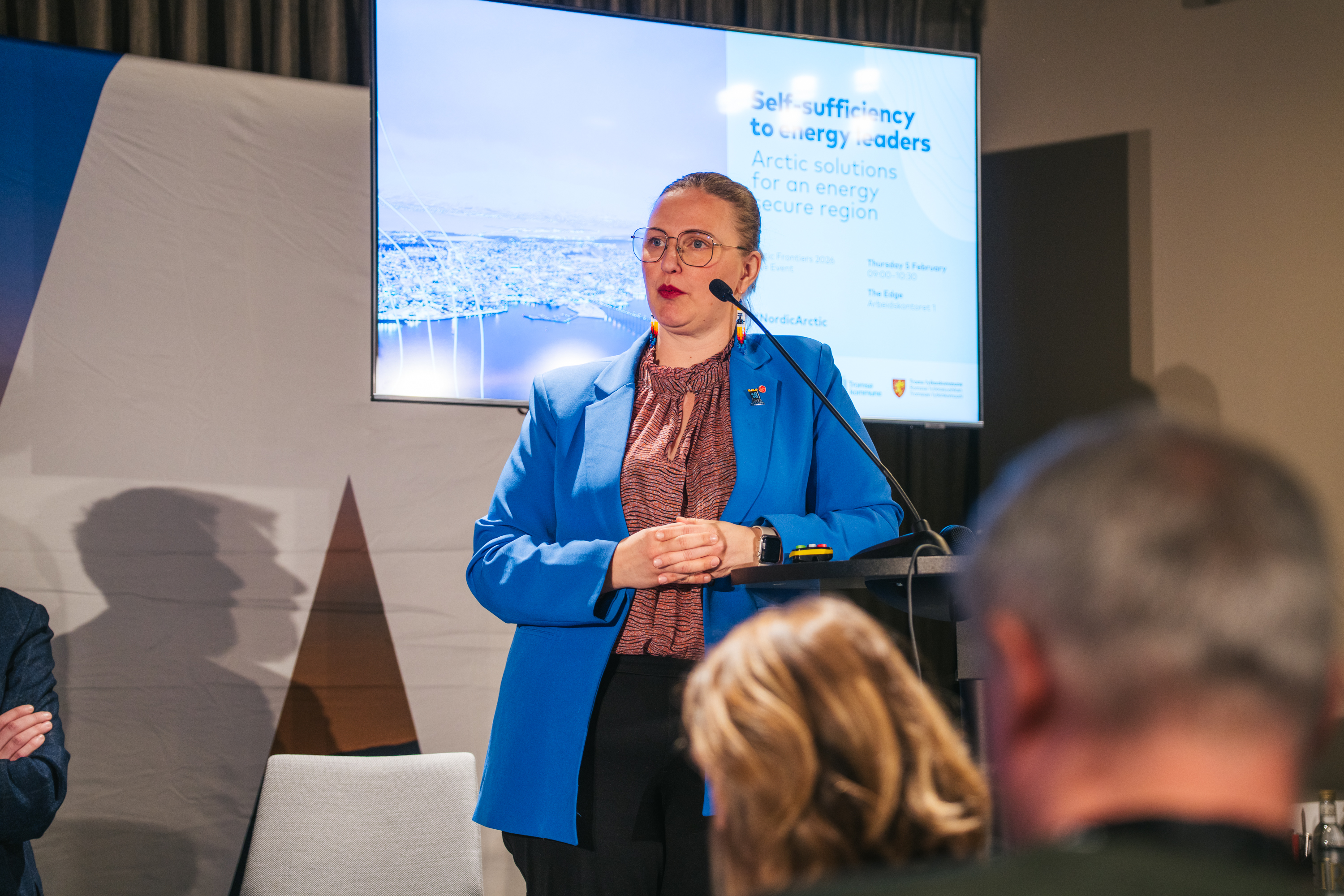
Carina Sammeli, Mayor of Luleå. Photo: David Jensen @jensenmedia / Arctic Frontiers.
Luleå, a northern Swedish port city long accustomed to energy abundance, now faces potential shortages due to the green shift and new investments. Mayor Carina Sammeli highlighted the importance of getting things right from the start – from building new grids to ensuring fast distribution. But every new project can also spark conflict: a grid cutting across backyards, a port expansion forcing people to sell their homes.
“Our solution is to get everyone in the same room to understand the same issue. People are smart and want to help each other, but they need to understand differing perspectives,” Sammeli said.
In this context, one principle stands out: “nothing about us without us.” As Patti Bruns emphasised, free, prior, and informed consent is essential for any successful energy project. Without community buy-in – and, where needed, appropriate compensation for Indigenous Peoples and local communities – the energy transition will not succeed.
Municipalities, however, cannot secure local energy needs alone. Tromsø municipality, therefore, is developing a proof of concept for collaboration between different actors to keep critical infrastructure running during emergencies.
Håland offered an illustrative example: local transport. With increased electrification and no rail infrastructure, society comes to a standstill if transport fails. So how can power be redirected during crises? “We found that cruise ships can be a possible energy source. They are basically floating cities that, when docked, can supply electricity to local infrastructure,” he noted.
Partnerships with private companies can increase preparedness and offer business opportunities. Cities like Luleå and Oulu already buy excess heat from local industries to warm homes.
At the same time, Kimmo Alatulkkila, director of development of energy systems at Oulun Energia, warned to enter relationships with care to not end up in another cycle of dependencies. New technologies often depend on external suppliers and materials, potentially creating new dependency cycles. “We need to reflect on the dependencies we are creating through new investments and consider which partners are truly trustworthy,” he said.
Arctic energy security is a package of solutions
The discussions made clear that dependence on external supplies remains a major driver of energy insecurity in the Arctic. It undermines resilience and slows the shift toward sustainable Arctic societies. The green transition can help communities reduce risks and build thriving futures, but only if it is shaped on their terms and includes all affected stakeholders.
At the same time, the Arctic’s environment will remain harsh, and infrastructure investments will stay expensive. “The resilience package is not just renewables,” noted Klaus Skytte. It must also include:
- hybrid systems centred on renewables but with firm backup solutions
- storage designed for realistic risk scenarios, not just daily balancing
- fuel and parts inventories adapted to Arctic logisticsparts inventories adapted to Arctic logistics
- robust contingency plans that assume interconnectors may fail
Ultimately, the strength lies in treating the green transition as a comprehensive resilience strategy.